
Route blockades and instability in the Persian Gulf are transforming Europe’s booking map, turning the Western Mediterranean into the hotel sector’s new economic shield.
By Ehab Soltan
HoyLunes – A German family that just six months ago was planning a vacation in the Eastern Mediterranean may end up booking in Mallorca, the Canary Islands, or the Costa Brava without having changed their budget or their dates. The only thing that has changed is their perception of risk.
We live on a hyper-connected planet where an event in a maritime strait thousands of miles away can instantly alter the price of a hotel room on the European coast. The tourism economy no longer depends solely on the weather or the quality of service. Air route disruptions, rising transport insurance costs, or travel warnings issued by governments can modify the demand for certain destinations in a matter of weeks.
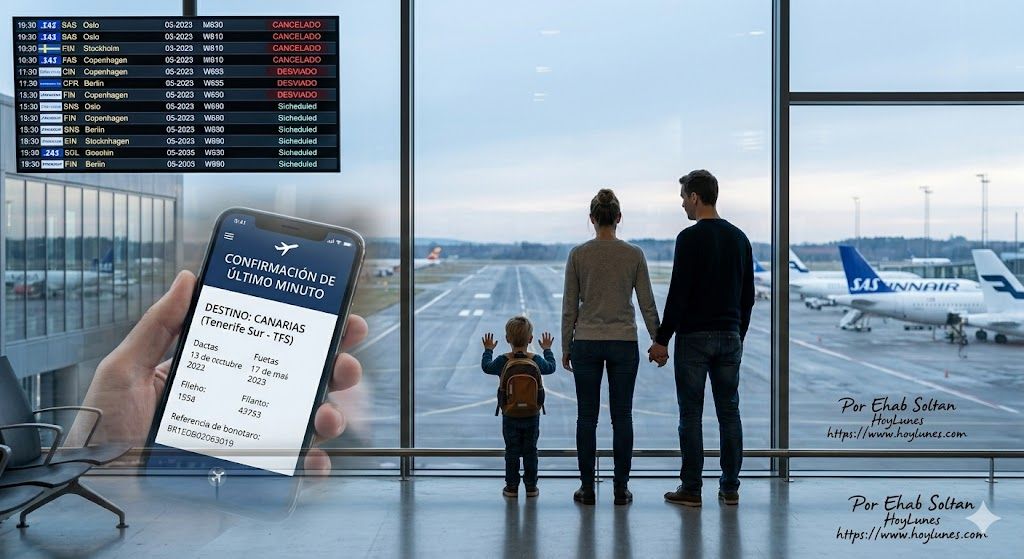
When geopolitical tension escalates in critical nodes such as the Persian Gulf or the Strait of Hormuz, capital and tourism react in the exact same way: by seeking a safe haven.
This phenomenon, known in international economics as the diversion of flows due to risk, is contributing to an observable redistribution of international tourist flows. While certain regions suffer the uncertainty of instability, stable destinations like Spain —and specifically insular and coastal regions such as the Canary Islands and Catalonia— are experiencing significant increases in demand in certain destinations of the Western Mediterranean. This is not a casual market fluctuation, but a mathematical constant in global crisis management.
How Travelers React to Uncertainty
Analysts observe a recurrent pattern: travelers tend to prioritize destinations perceived as safe when international uncertainty increases. The international traveler, especially those from high-purchasing-power source markets like Northern Europe or North America, does not cancel their vacation in the face of a geopolitical crisis; they simply change coordinates.

When air or maritime routes in the Near East and the Eastern Mediterranean are perceived as friction zones, the flow of travelers shifts immediately toward the Western Mediterranean.
This massive displacement generates a direct impact on the law of supply and demand:
Positive saturation: Hotels in safe haven zones register unforeseen spikes in demand.
Rate inflation: As more customers seek the same rooms, the prices of accommodation and tourism infrastructure inevitably rise, affecting both investors and final consumers.
“The international traveler with high purchasing power does not cancel their vacation in the face of a geopolitical crisis; they simply change coordinates toward the Western Mediterranean”.
However, the behavior of the tourism market never responds to a single variable. Although safety acts as the primary catalyst or “entry filter,” the actual materialization of this diversion of travelers depends on a multi-factor mechanism. Factors such as **direct air connectivity**, stability in **exchange rates**, flexibility in cancellation policies, and the aggressiveness of **local promotional campaigns** determine which specific destinations successfully absorb that redirected demand. Geopolitics opens the opportunity, but infrastructure and economic competitiveness consolidate it.
Collateral Impact on the Arab Region (Strategic Analysis)
From a regional economic perspective, the blocking of corridors and the escalation of tension not only halt the arrival of foreign visitors to the directly affected nations, but also alter the balances of payments of the region’s emerging economies.
Capital destined for tourism megaprojects in the Middle East adopts a cautious stance, slowing down multi-billion dollar investments and diverting the interest of international investment funds toward European hotel assets, which are considered low-risk values. The resilience of current European tourism is largely funded by the opportunity cost paid by other regions of the globe.
The Lesson for the Investor and the Traveler
The trend of current markets demonstrates that institutional stability and legal certainty are a nation’s most valuable assets. For European tour operators and travelers from strong economies (such as Germany or the United Kingdom), the price increase in Southern Europe is the necessary “toll” to guarantee peace of mind.
Travelers rarely analyze geopolitical maps before booking a vacation. However, millions of individual decisions made for safety reasons end up modifying prices, investments, and business strategies worldwide.
“The resilience of current European tourism is largely funded by the opportunity cost and political risk that currently penalize other regions of the globe”.
One of the most consistent conclusions emerging from recent international crises is that **stability has become a first-order economic asset**. The tourism industry can no longer be analyzed in isolation. Hotels no longer compete only with the neighboring hotel; they compete against the global political risk index. On the world stage, a territory’s peace and stability are, today more than ever, the most highly quoted raw material of the modern economy.
#GlobalTourism #GeopoliticalEconomics #HotelMarket #TourismInvestment #HoyLunes #EhabSoltan #InternationalEconomics #FlowDiversion